Ball Sort - Color Puz Game
- 4.8
- Rating
- 50.00M
- Installs
- Free
- Price

 Analysis by App-foxy
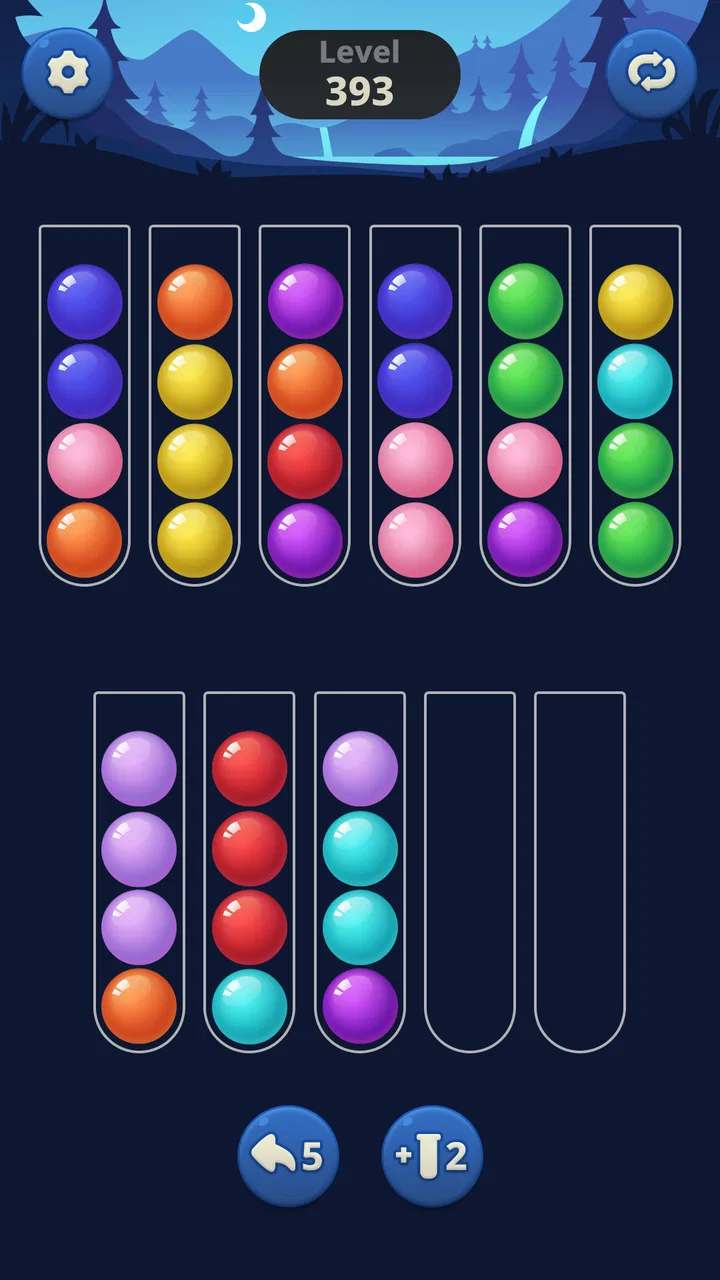
I spent time with Ball Sort - Color Puz Game as a light puzzle game rather than something meant to dominate my attention. Its central idea is easy to understand: move colored balls between tubes until matching colors are grouped together. That familiar format makes it immediately approachable, but the real appeal is how quickly a simple board can turn into a careful planning exercise.
This is a free game from Infinite Joy Ltd. in the puzzle category, rated for Everyone. It has reached over 50 million installs, with an average rating of 4.8 from around 93 thousand ratings and roughly 3.3 thousand written reviews. Those numbers suggest that the basic format has found a large audience, although popularity alone does not tell you whether its particular presentation will suit you.
My overall impression is positive, with one important qualification: this is best when you want a quiet, repeatable sorting challenge, not when you are looking for a story, a deep campaign, or a highly competitive puzzle experience. The game’s strength is its low barrier to entry. Its limitation is that the same simplicity can eventually feel repetitive.
You May Also Like

 Blood Strike: 2.5 Anniversary
Blood Strike’s Loadouts Turn Every Drop Into a Tactical Gamble
A close look at Blood Strike’s custom loadouts: how fast access to signature weapons reshapes its battle royale rhythm, rewards preparation, and narrows the gap between fights.

 Pandora - Music & Podcasts
Pandora’s Music Is Easy to Start, but Harder to Recover
Pandora’s strength is its low-effort path from a seed to a station. Its weak spot is how much confidence it asks you to place in connection, setup, and quiet recovery.

 8 Ball Pool
 Is Built on Rivalries, Rematches, and Routine
A close look at the rivalries, rematches, shared routines, and unanswered safety questions that turn a quick pool match into a persistent mobile community.

 Samsung Music
’s Quiet Strength Is Playing What You Already Own
Its reach comes less from spectacle than from dependable access to a personal library. That simplicity is both the app’s strongest retention engine and its ceiling.

 AccuWeather: Weather Radar
AccuWeather Review: A Quick, Clear Forecast for Everyday Decisions
For everyday plans, the best forecast is the one you can understand quickly. AccuWeather makes rain timing, radar, and local conditions easy to act on, with a few trade-offs.

 Hill Climb Racing
Why Hill Climb Racing Still Turns Crashes Into One More Run
A tiny car, a bumpy hill and one more upgrade: Hill Climb Racing keeps resurfacing because its simple chaos makes every near-miss feel personal.
More From Our News Desk
View All News


How the sorting loop feels in everyday play
Each puzzle asks me to think about space, order, and consequences. A move that looks helpful can block access to a buried color, while an apparently empty tube becomes valuable because it gives me room to reorganize. I do not need to learn complicated controls. The challenge comes from choosing the right sequence, not from reacting quickly.
That makes it particularly comfortable for short sessions. I can play while waiting for an appointment, during a quiet break, or at the end of the day when I want something more engaging than scrolling but less demanding than a full action game. The game does not require me to remember a plot or maintain a long chain of tasks. I can put it down and return later without feeling lost.
The first few boards are easy to read because the goal is visually obvious. As the arrangement becomes less convenient, the useful skill is not simply spotting matching colors. I found myself counting available spaces, identifying which tube should remain open, and avoiding moves that create a dead end. That gradual shift from recognition to planning gives the format more substance than its short description suggests.
A practical habit helped me more than rushing: before moving anything, I looked for colors that were already partly exposed and considered where the next two or three moves would leave them. This prevents the common mistake of filling a tube too early. In a color-sorting puzzle, a correct move now can still be a poor move if it removes the only flexible space on the board.
Why the controls work well for casual players
The touch interaction is naturally suited to the concept. Selecting a tube and moving its contents feels more direct than navigating menus or learning a virtual control scheme. That simplicity also makes the game accessible to people who do not usually play puzzle games. Someone can understand the objective after seeing a single board, then decide whether the increasing planning requirement is enjoyable.
I also appreciate that the format does not depend on fast fingers. Players who prefer thoughtful games can take time before committing to a move. That matters for anyone who finds timed puzzles stressful or who wants to play with one hand during a short break. The game’s relaxed structure is a better fit for deliberate players than for people who want constant action.
There is a trade-off, though. Because the interaction is so straightforward, the experience depends heavily on the quality and variety of the puzzles. If you need new mechanics, characters, or a strong sense of progression to stay interested, sorting tubes may not hold your attention for long. The appeal is in refining your decisions within a familiar rule set.
Small decisions that make difficult boards manageable
My most useful approach was to treat empty space as a resource rather than as a place to dump a color. I tried to preserve at least one flexible tube whenever possible, especially when several colors were still buried. I also avoided completing a color immediately if doing so would trap another ball beneath it or remove a useful route for rearrangement.
Another helpful technique was separating “safe” moves from “committing” moves. A safe move exposes information without using up much room. A committing move fills a tube or creates a long sequence that is difficult to undo. Making the safer moves first lets me understand the board before I narrow my options.
When I made a mistake, restarting mentally was often better than continuing automatically. A few extra moves can turn a clean solution into a cramped position. This is where the game becomes a small exercise in planning rather than a reflex challenge. It rewards patience, but it can also punish careless tapping.
For a realistic everyday example, I would use it during a ten-minute train ride. I might finish one simple board, begin a more complicated one, and stop without needing to preserve a complicated narrative state. That makes it more convenient than a larger puzzle game when I only have a few spare minutes. On the other hand, if I wanted a session with a clear ending and a memorable payoff, I would choose something with a campaign or level-based story instead.
Spending, pressure, and the question of fairness
The game is free to download, which makes trying it low risk from a purchase standpoint. Its listed in-app purchases are priced at $4.99 per item. That is the clearest spending fact I can use when judging it: optional purchases exist, and each listed item carries that price point. I would still advise checking the purchase prompt carefully before confirming anything, especially if someone else uses the device.
I did not treat the presence of purchases as proof that the game is unfair. A paid option can be acceptable if the core puzzles remain enjoyable without spending. What matters to me is whether the player feels pushed to pay whenever a board becomes difficult. The sorting format itself does not need a paid advantage to make sense; the satisfaction comes from finding a solution. That is why I would personally prefer to play normally and regard any purchase as something to consider only after deciding that the game has lasting value for me.
The more important pressure is mental rather than financial. A difficult board can tempt me to make hurried moves simply because I want to finish. That is exactly when the puzzle becomes less enjoyable. I found it better to pause, inspect the available space, and restart my plan than to assume that persistence alone would solve the position.
For parents, the Everyone rating is reassuring as a broad age classification, but it should not be confused with a promise that every child will enjoy the same level of challenge. Younger players may understand the colors quickly yet struggle with planning several moves ahead. The game can be a calm logic activity, but an adult may still want to guide a child toward taking turns slowly rather than tapping randomly.
Is it a competitive game?
I would not choose this title for competition. Its appeal is personal problem-solving, not proving that I am faster or stronger than another player. That is a positive point for anyone who dislikes leaderboards or social pressure, but a weakness for anyone who wants direct rivalry, shared matches, or a visible ranking climb.
In that sense, fairness is easier to judge than in a multiplayer puzzle. There is no need for me to compare my result with another person to enjoy the board. My standard is simply whether the rules give me a reasonable chance to think through the arrangement. A quiet solo puzzle can feel fair even when it is difficult, provided the challenge comes from the layout rather than from forced urgency.
Compared with a crossword, the game asks less from language and more from spatial planning. Compared with a match-three game, it is slower and more deliberate, with less emphasis on chains, speed, or visual excitement. Compared with a physics puzzle, it offers fewer surprises and less experimentation. I would pick this one when I want a clean logic task, but I would choose those alternatives when I need richer variety or a stronger sense of discovery.
Where the experience may become repetitive
The central weakness is also the central identity of the game: sorting remains sorting. Even when the arrangement gets harder, the basic action does not change. Players who enjoy optimizing a familiar system may find that satisfying, while players who need new rules may eventually feel that they are solving variations of the same problem.
This is not necessarily a flaw for short sessions. Repetition can be useful when I want a predictable way to unwind. It becomes a problem when I expect a long-term hobby with constant surprises. Before spending money, I would play enough free content to decide whether the basic loop still feels rewarding after the initial novelty fades.
There is also a difference between relaxing and effortless. The game can be calming because it is quiet and focused, but a complex arrangement may still require concentration. I would not start a difficult board when I am already tired and looking for something completely passive. A simple video or an idle game would suit that mood better.
Version, access, and what I would check before installing
The current version is 1.18.0, and the game requires Android 8.0 or later. That makes the compatibility requirement fairly clear for Android users: older devices below that system version are not the right target. If I were installing it on a family phone or an older spare device, I would check the operating system first rather than assuming that every Android handset can run it.
The game is also positioned as an Everyone title, so it is suitable for a broad audience in terms of its age classification. I would still make the spending decision separately. A child-friendly rating does not remove the need to supervise purchases on a shared device, particularly when individual items cost $4.99.
One thing I would not do is judge the game solely by its large install count or high average rating. Those figures show strong adoption and broadly positive reception, but they cannot tell me whether I personally enjoy repeating color arrangements. My own test would be simple: do I look forward to the next board after making a mistake, or do I feel that I have already seen everything the format offers?
I would also keep expectations realistic about the word “challenge.” The puzzle can challenge planning and patience, but it is not a test of general intelligence, and difficulty can vary depending on how familiar someone is with this type of arrangement. A player who has used many ball-sort games may understand the best tactics quickly, while a first-time player may need time to develop a reliable method.
Who should install it, and who should skip it?
I recommend it to people who want a free, solo color sorting puzzle that can be played in short bursts. It is especially suitable if you enjoy organizing objects, thinking ahead, and solving a board without timers or rapid reactions. It can also work well for someone who wants a simple mental break between more demanding tasks.
I would skip it if your priority is a story, character development, online competition, or constantly changing gameplay. I would also look elsewhere if you dislike restarting a puzzle after a poor sequence of moves. The game’s satisfaction comes from planning correctly, so players who prefer forgiving, automatic progress may find it more frustrating than relaxing.
It is a reasonable choice for a child or adult who is new to mobile puzzles because the objective is easy to understand. More experienced puzzle fans should ask whether the familiar format itself is enough. If you already know that tube-sorting games keep your attention, this is an accessible option. If you need unusual mechanics, a physics-based title or a word puzzle may offer more variety.
My trust verdict after weighing the trade-offs
My final view is that this is a straightforward casual puzzle with a clear purpose. Infinite Joy Ltd. has built the experience around a rule set that needs almost no explanation, and that makes it easy to recommend to a friend who wants something calm and immediately playable. The free entry point is helpful, while the $4.99-per-item purchase structure is something I would approach deliberately rather than automatically.
The game feels fairest when I treat it as a personal logic exercise, not as a competition or a race toward an imagined finish line. I would not spend simply because a board has become difficult. I would first try a slower plan, preserve empty space, and restart if my earlier moves have closed off the solution. Those habits improve the experience without changing what the game is.
Its strongest use case is a short, focused break. Its weakest use case is a long session for someone who needs constant novelty. That distinction matters more than the high rating or the large audience. A popular puzzle can still be the wrong fit if its repeating structure does not match your taste.
For me, the trust verdict is cautiously positive: the game is easy to understand, broadly accessible, and honest about being a simple sorting challenge. I would install it when I wanted a low-pressure solo activity, keep purchases optional, and decide on long-term use based on whether the boards continued to feel satisfying. It is a good pick for calm planning, not a substitute for a deep puzzle adventure.
FAQs for Ball Sort - Color Puz Game
01What is Ball Sort - Color Puz Game?
Ball Sort - Color Puz Game is a fun and engaging puzzle game available on both Android and iOS platforms. The objective is to sort colored balls into tubes until each tube contains balls of the same color. It’s a great way to challenge your logical thinking and problem-solving skills.
02Is Ball Sort - Color Puz Game free to play?
Yes, Ball Sort - Color Puz Game is free to download and play. However, it contains in-app purchases and ads that can enhance the gaming experience. Players can choose to buy additional features or remove ads, but these purchases are completely optional.
03Can I play Ball Sort - Color Puz Game offline?
Yes, one of the great features of Ball Sort - Color Puz Game is that it can be played offline. This makes it perfect for users who want to enjoy the game without relying on an internet connection, such as when traveling or in areas with limited connectivity.
04What are the system requirements for Ball Sort - Color Puz Game?
Ball Sort - Color Puz Game is designed to run smoothly on most modern Android and iOS devices. It requires iOS 10.0 or later for Apple devices and Android 5.0 or above for Android devices. Make sure you have enough storage space available for the installation.
05Are there any tips for beginners in Ball Sort - Color Puz Game?
For beginners, it’s important to plan your moves ahead and focus on creating empty spaces to maneuver the balls effectively. Always prioritize sorting the colors that have fewer balls first. Take your time to think through each move, as rushing can lead to mistakes and fewer opportunities to sort the colors correctly.
Pros
- Simple and intuitive gameplay.
- Visually appealing color palette.
- Suitable for all age groups.
- Offline mode available.
- Regular updates with new levels.
Cons
- Ads can interrupt gameplay.
- No multiplayer mode available.
- Limited hints can be frustrating.
- Repetitive background music.
- In-app purchases for extra features.

Ball Sort - Color Puz Game
Gallery